"What would you do if a doctor refused to see you?"
Every well-prepared candidate has a perfect answer. Build rapport, find a reason to come back, ask the nurse, bring value. It sounds great, and it tells me almost nothing.
The question I prefer is almost the same, but in the past tense:
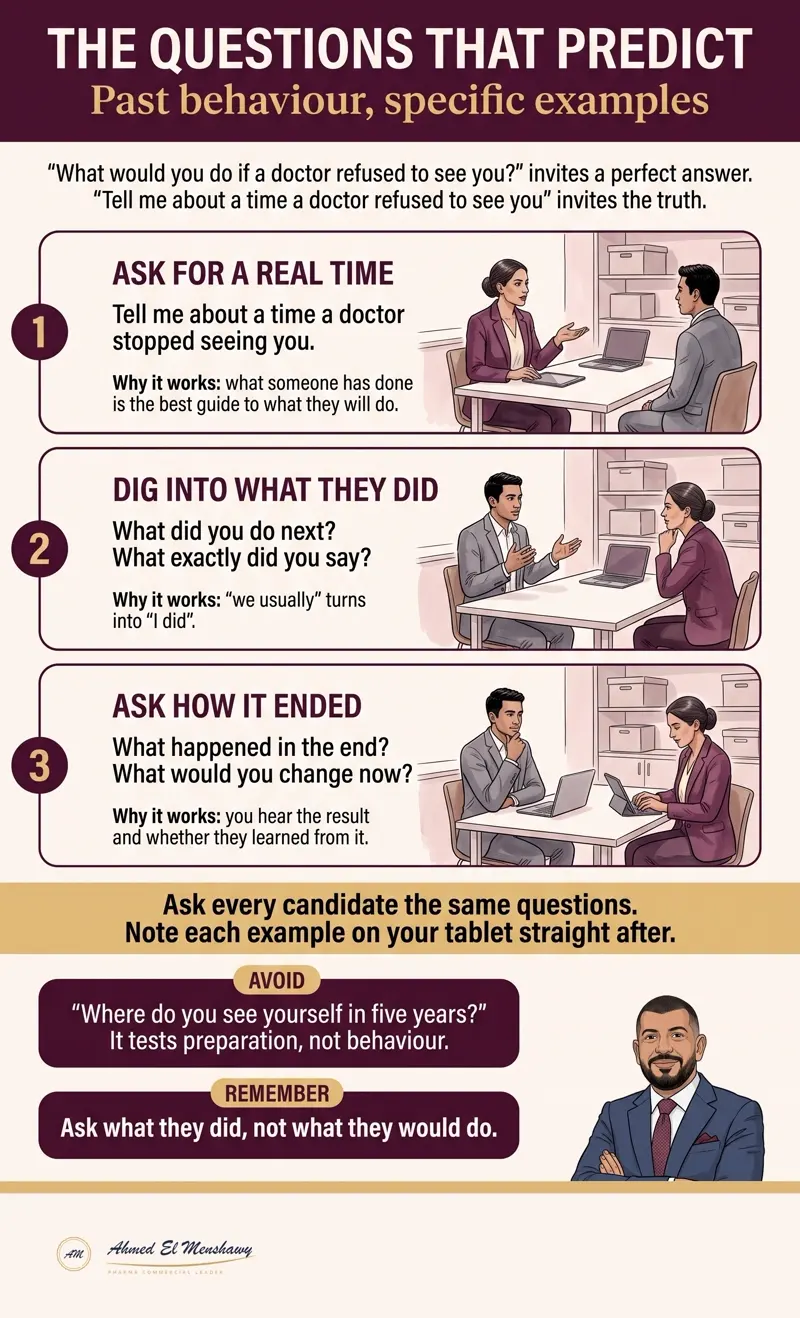
"Tell me about a time a doctor stopped seeing you."
Then I keep going.
- "What did you do next? What exactly did you say?"
- This is where "we usually" turns into "I did". Or where the story goes vague, which is also an answer.
- "What happened in the end? What would you change now?"
- I hear the result, and I hear whether they learned anything from it.
The idea behind behavioural interviewing is simple: what someone has done is the best guide to what they will do. Hypothetical questions test how well a candidate has prepared. Past-behaviour questions test how they actually work.
Two habits make it fair. Every candidate gets the same questions. And I note each example on my tablet straight after, before the next interview blurs it.
A fresh graduate can answer these too. A time they persuaded someone, recovered from a setback, kept a promise that was hard to keep.
“Ask what they did, not what they would do.”
Lesson 2 of 12 in Step 7: Hiring and onboarding, with the full guide and a checklist for this week.