Most trial slides hand the doctor a percentage. The best reps hand him a number of patients.
The number needed to treat was introduced in 1988 in the New England Journal of Medicine by Laupacis, Sackett and Roberts, to turn trial results into something a clinician can picture. It answers one simple question: how many patients do I need to treat for one extra patient to benefit?
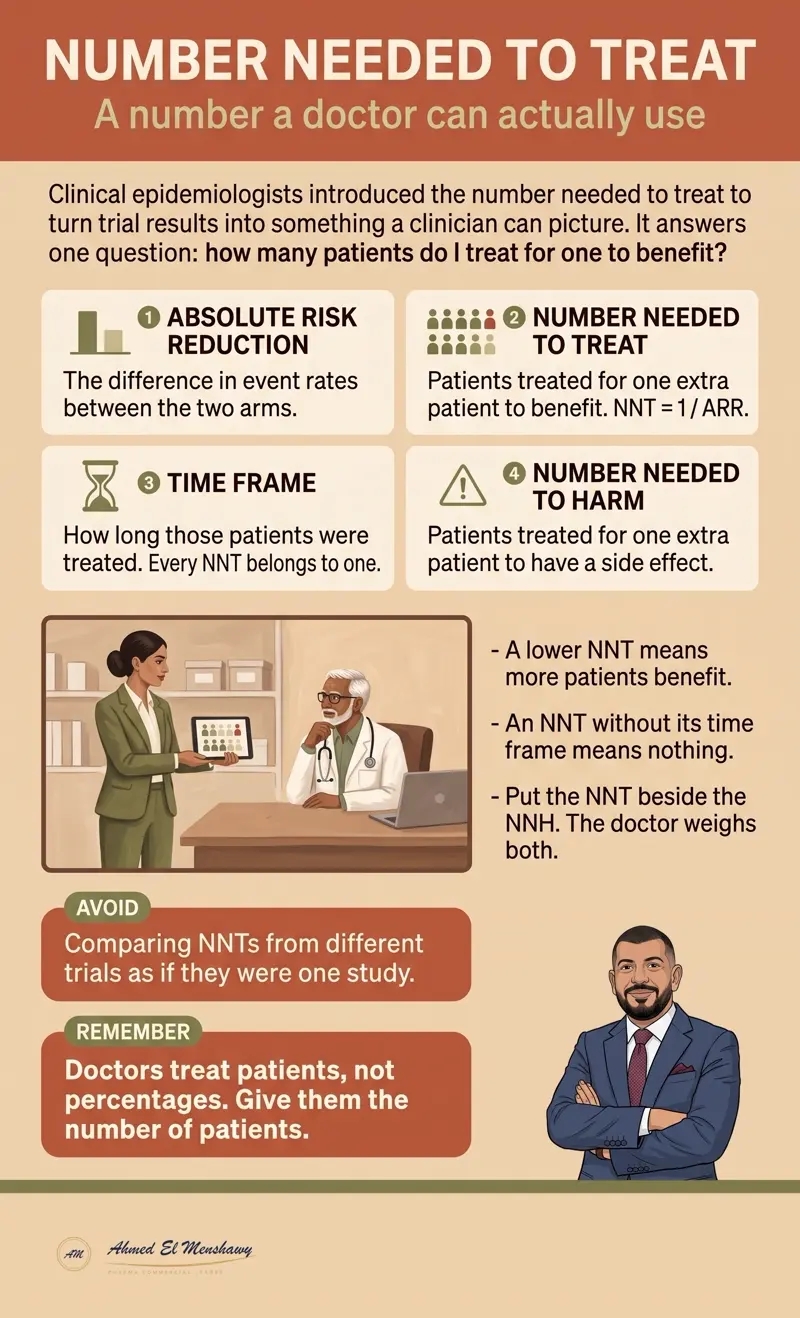
The four numbers worth knowing for your key trial:
- Absolute risk reduction: the difference in event rates between the two arms.
- Number needed to treat: one divided by the absolute risk reduction.
- Time frame: how long those patients were treated. Every NNT belongs to one.
- Number needed to harm: patients treated for one extra to have a side effect.
- How to read them:
- A lower NNT means more patients benefit.
- An NNT without its time frame means nothing.
- Put the NNT beside the NNH. The doctor weighs both, so show both.
And never line up NNTs from different trials as if they came from one study.
“Doctors treat patients, not percentages. Give them the number of patients.”
Lesson 5 of 11 in Step 3: Knowing the science, with the full guide and a checklist for this week.