The same trial result can be told as a big number or a small one. Good doctors always ask which one you are showing them.
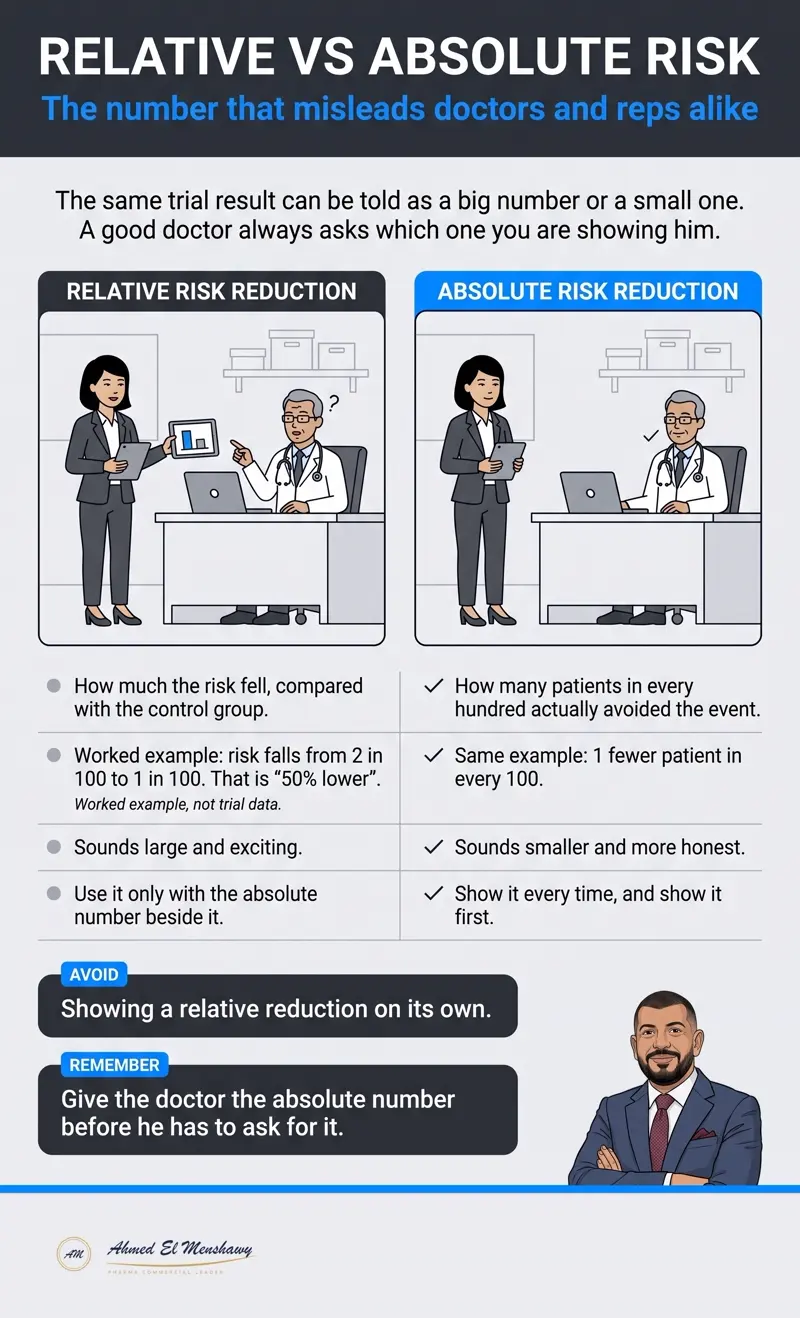
Relative risk reduction tells you how much the risk fell compared with the control group. Absolute risk reduction tells you how many patients in every hundred actually avoided the event. Both are true. Only one of them sounds exciting.
A simple worked example, not from any trial:
- Risk falls from 2 in 100 to 1 in 100.
- Relative: "50% lower."
- Absolute: 1 fewer patient in every 100.
Same result. Very different impression.
- The rule I give every rep:
- Never show a relative reduction on its own.
- Put the absolute number beside it.
- Show the absolute number first.
A specialist who hears only the relative figure assumes you are hiding the other one. Often he is right. The rep who offers both is the rep he starts to trust with data.
“Give the doctor the absolute number before he has to ask for it.”
Lesson 3 of 11 in Step 3: Knowing the science, with the full guide and a checklist for this week.