Ask most teams how their market is segmented and you get a doctor list.
Top prescribers by volume, split into A, B and C, handed to the reps.
That is targeting. It is useful. But it is a rep-level decision, and it cannot tell a country where to put its people and budget.
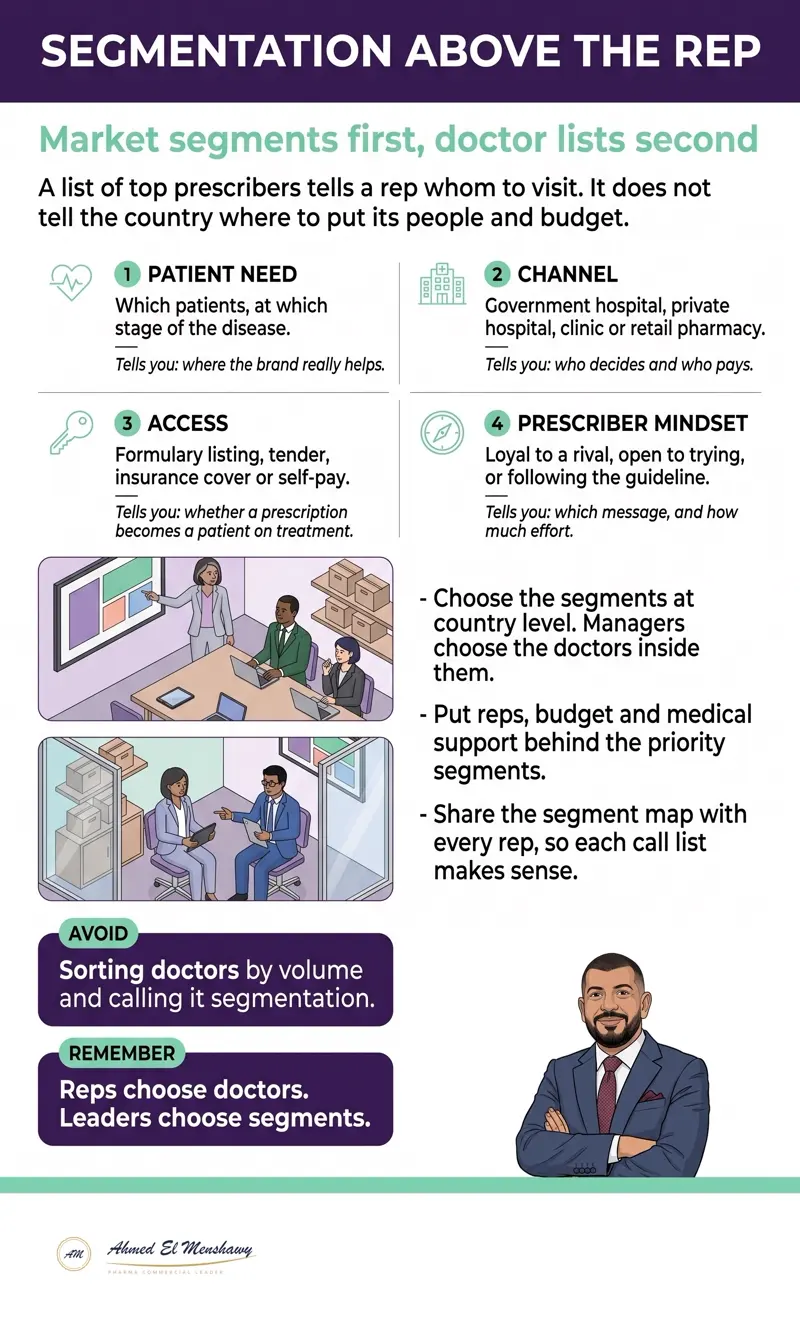
Segmentation above the rep asks different questions.
Which patients does the brand really help, and at what stage of the disease?
Which channel? Government hospital, private hospital, clinic or retail pharmacy. Each has different decision makers and different payers.
What access does the patient have? Formulary listing, tender, insurance cover or self-pay. A prescription that cannot be filled helps nobody.
What is the prescriber's mindset? Loyal to a rival, open to trying, or following the guideline.
Once those segments are clear, the rest follows.
The country chooses the segments. First-line managers and reps choose the doctors inside them. Reps, budget and medical support go where the priority segments are.
And in my teams the segment map is shared with every rep, so each call list makes sense to the person who has to use it.
“Reps choose doctors. Leaders choose segments.”
Lesson 10 of 16 in Step 1: Setting strategy, with the full guide and a checklist for this week.