Most training calendars I have reviewed look busy.
A workshop in March. Another in June. A refresher before the new cycle. Each one booked when a trainer or a room was free.
Reps attend, rate the day highly, and go back to the field doing what they did before.
A calendar is a list of events. A curriculum is a sequence.
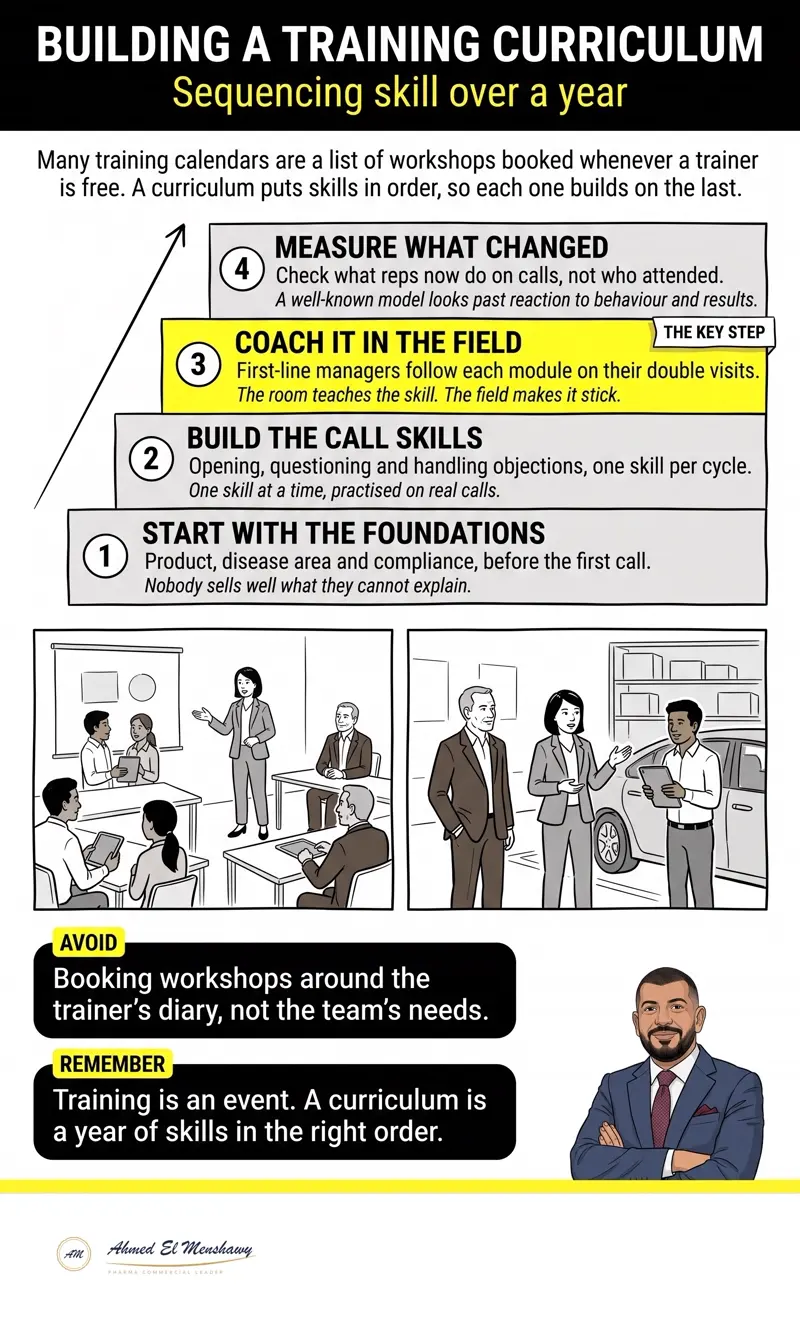
In my teams, the year is built in four layers.
Foundations first. Product, disease area and compliance. Nobody sells well what they cannot explain, and nobody should be in front of a doctor without the rules.
Then the call skills, one per cycle. Opening, questioning, handling objections. Each one practised on real calls before the next one starts.
Then the step most plans skip: first-line managers coach each module on their double visits. The room teaches the skill. The field makes it stick.
Finally, measure what changed. Kirkpatrick's model asks us to look past whether people enjoyed the session, to what they now do differently and what it produced. That is the only evaluation I trust.
None of this needs a bigger budget. It needs an order, and managers who know what their team learned last month.
“Training is an event. A curriculum is a year of skills in the right order.”
Lesson 7 of 17 in Step 5: Building the organisation, with the full guide and a checklist for this week.