A country plan often has one line for the market.
Then, somewhere lower down, hospital and retail appear as two columns of the same forecast.
In my experience they are two different businesses that happen to share a product.
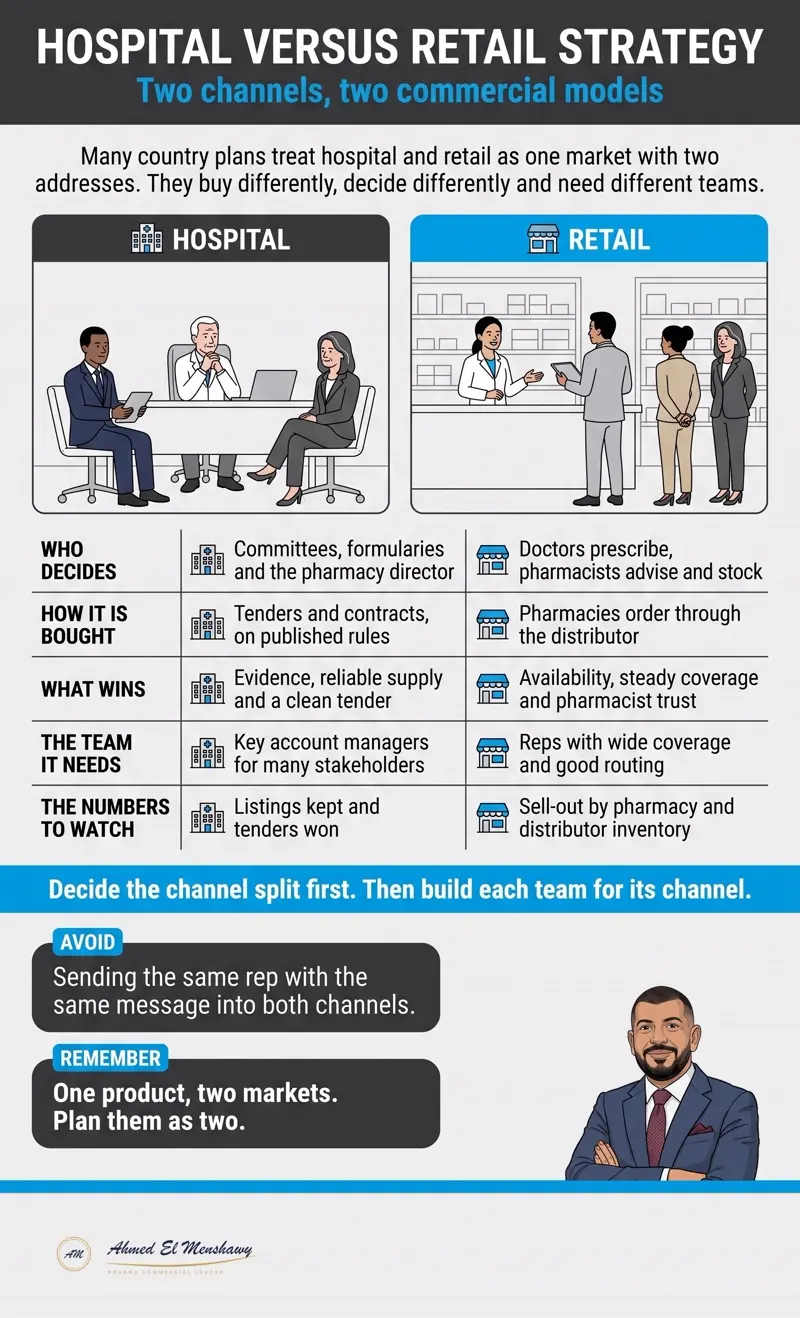
In a hospital, the decision sits with committees, formularies and the pharmacy director. The product is bought through tenders and contracts, on published rules. What wins is evidence, reliable supply and a clean tender file.
In retail, the doctor prescribes, the pharmacist advises and decides what to stock, and the pharmacy orders through the distributor. What wins is availability, steady coverage and the pharmacist's trust.
So the teams are different too. Hospitals need key account managers who can work with many stakeholders at once. Retail needs reps with wide coverage and good routing.
Even the numbers differ. In hospitals I watch listings kept and tenders won. In retail I watch sell-out by pharmacy, and the distributor inventory behind it.
The mistake I have made, and seen others make, is one rep with one message sent into both. It usually does neither well.
Decide the channel split first. Then build each team for its channel.
“One product, two markets. Plan them as two.”
Lesson 8 of 17 in Step 4: Distributors and market access, with the full guide and a checklist for this week.