Not every launch works.
When one misses, the first question in the room is usually: who got it wrong?
It is the easiest question. It is also the least useful, because once people feel blamed, they stop telling you what really happened.
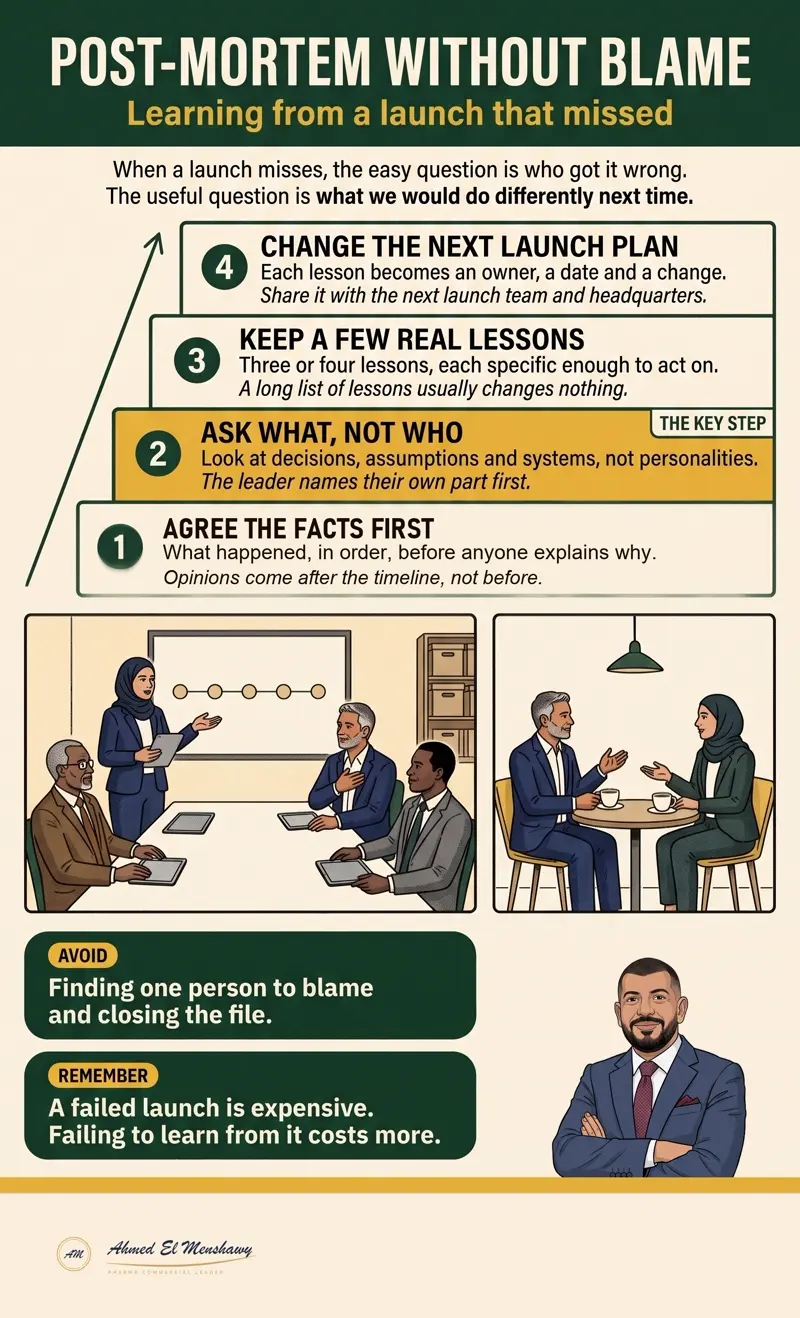
In my experience, a good post-mortem follows four steps:
Agree the facts first. What happened, in order, before anyone explains why. Opinions come after the timeline.
Ask what, not who. Look at decisions, assumptions and systems. Was the forecast built on hope? Was the access plan ready? Did the field have what it needed? And the most senior person in the room names their own part first. If the leader does not, nobody else will.
Keep a few real lessons. Three or four, each specific enough to act on. A long list usually changes nothing.
Change the next launch plan. Each lesson gets an owner, a date and a concrete change, and it is shared with the next launch team and with headquarters.
The aim is not to feel better about a bad year. It is to make sure the next launch does not pay for the same mistake.
“A failed launch is expensive. Failing to learn from it costs more.”
Lesson 10 of 10 in Step 8: Execution and the operating rhythm, with the full guide and a checklist for this week.