Most field teams can tell you how many calls they made last month.
Very few can tell you what one of those calls cost.
In my experience, working that number out once changes a lot of conversations.
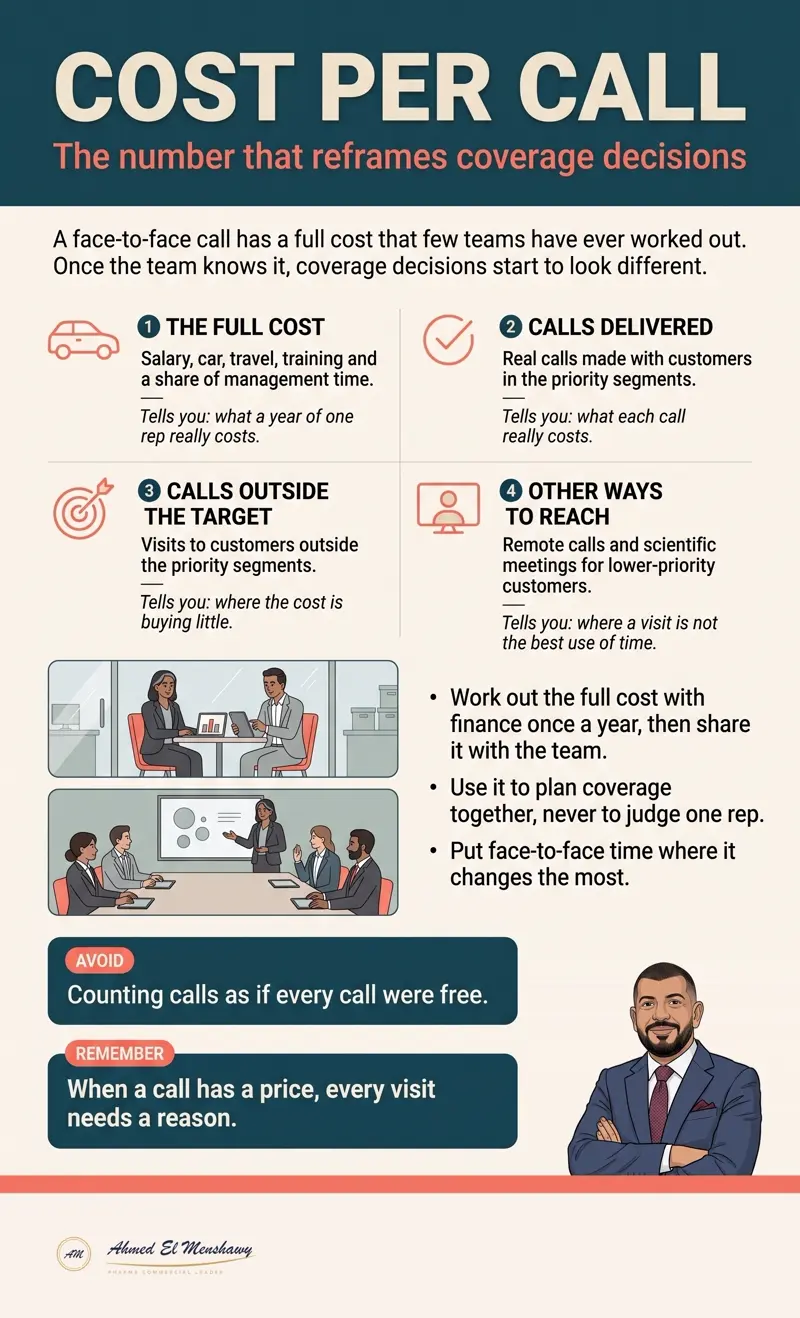
Start with the full cost of a rep for a year. Salary, car, travel, training, and a fair share of the manager's time.
Divide it by the real calls made with customers in the segments we chose. That is the cost of a call.
Then two questions follow on their own.
How many calls go to customers outside the priority segments? That is where the cost is buying the least.
And which customers could be served just as well another way? A remote call. A scientific meeting. Not every relationship needs a car and a morning.
Two rules matter here.
The number is shared with the whole team. It is a planning tool, not a hidden one.
And it is used to plan coverage together, never to judge one rep. The moment it becomes a stick, people start protecting their call counts instead of their customers.
Used well, it moves face-to-face time to where it changes the most.
“When a call has a price, every visit needs a reason.”
Lesson 11 of 17 in Step 3: Money, pricing and forecast, with the full guide and a checklist for this week.