Most forecasts I have been asked to challenge had the same problem.
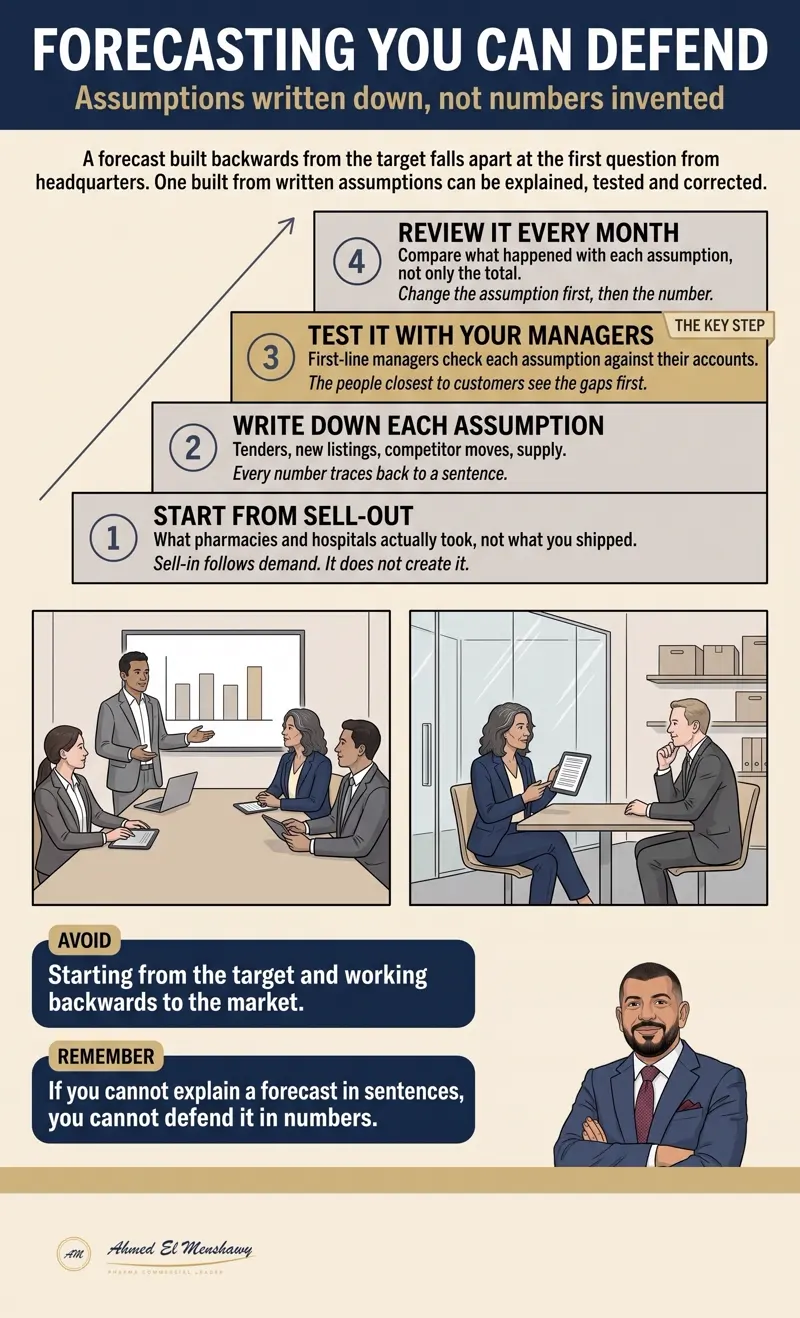
They started from the target and worked backwards to the market.
The number looked fine. Then headquarters asked one question: "What has to be true for this to happen?" And nobody could answer in sentences.
The forecasts I trust are built the other way round.
Start from sell-out. What pharmacies and hospitals actually took, not what we shipped to the distributor. Sell-in follows demand. It does not create it.
Write down each assumption. Tenders, new listings, competitor moves, supply. Every number should trace back to a sentence someone can read and question.
Test it with your managers. First-line managers know which account is really growing and which one is about to switch. They see the gaps before any model does.
Review it every month. Compare what happened with each assumption, not only the total. When reality moves, change the assumption first, then the number.
This takes longer the first time. After that, the monthly conversation with the region changes. You stop defending a number and start discussing assumptions. That is a much better conversation to be in.
And when a forecast is missed, you know exactly which sentence was wrong.
“If you cannot explain a forecast in sentences, you cannot defend it in numbers.”
Lesson 5 of 17 in Step 3: Money, pricing and forecast, with the full guide and a checklist for this week.